The Great Disconnect: Navigating the Global Shift Toward Phone-Free Schools

Updated: Aug 14
For years, school districts managed smartphone use through trial, compromise, and inconsistent enforcement. That era is ending. By early 2026, phone-free school policies have shifted from optional guidance to statewide mandates in dozens of states. What the 2026 research makes clear, though, is that passing the policy is the easy part. The evidence on outcomes is more mixed than either side of the debate usually admits, and the difference between a policy that works and one that stalls lies almost entirely in how it is implemented.
For district leaders and administrators, the challenge is no longer whether to adopt a phone-free school policy, but how to implement compliant, enforceable, and equitable systems across K–12 schools while maintaining instructional continuity and family communication.
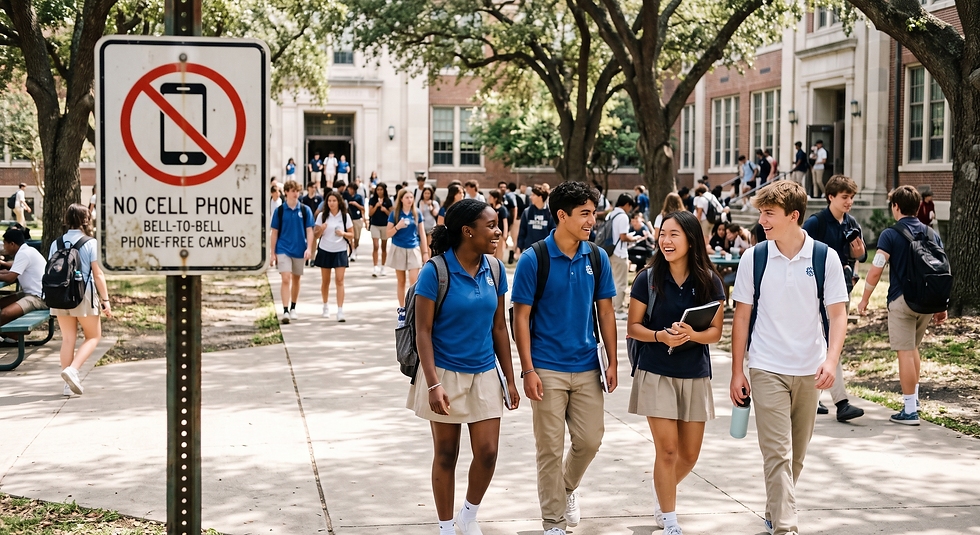
What District Leaders Need to Know About Phone-Free School Mandates in 2026
The acceleration of phone-free school legislation marks one of the fastest-moving policy shifts in modern K–12 education. What began as local experimentation has become a coordinated response to concerns about student attention, mental health, and academic outcomes. District leaders are now operating in an environment where policy clarity, operational readiness, and stakeholder communication matter as much as intent.
2026 Legislative Landscape: The Bell-to-Bell Era
In the United States, 2025 marked a tipping point. As of July 2026, at least 39 states and the District of Columbia require school districts to ban or restrict students' use of cell phones in schools, according to Education Week's state tracker. Several additional states have issued guidance or incentive-based frameworks encouraging districts to adopt similar restrictions.
Key U.S. State Mandates
New York (Fall 2025)
New York implemented one of the most comprehensive bell-to-bell phone restrictions in the country through its FY 2026 State Budget. The policy prohibits unsanctioned use of smartphones and other internet-enabled personal devices on school grounds for the entire school day, including lunch and non-instructional periods. Districts were required to adopt policies by August 1, 2025, with implementation beginning in the 2025–2026 school year.
California (July 1, 2026)
California’s Phone-Free School Act requires all school districts, charter schools, and county offices of education to develop policies limiting or prohibiting smartphone use by July 1, 2026, leaving implementation details to local control within state guidelines.
New Jersey (January 2026)
New Jersey passed statewide legislation establishing phone-free schools across K–12. The law restricts phone use during school hours, on school buses, and at school-sponsored events, with district-level implementation beginning in the 2026–2027 school year.
Massachusetts (Fall 2026)
Massachusetts now requires all public school districts to adopt cellphone-free policies by fall 2026, with defined exemptions for medical needs, disability accommodations, Individualized Education Programs, and approved off-campus activities.
Early-Adoption States
Florida, Louisiana, Georgia, and Arizona were among the first states to act. Florida introduced restrictions in 2023. Louisiana expanded bans to cover the full school day. Georgia passed the Distraction-Free Education Act for K–8 students, effective July 2026. Arizona now requires districts to limit cellphone use during instructional time.
Global Momentum Toward Phone-Free Schools
The shift is not limited to the United States.
Chile passed legislation in late 2025 banning smartphone use during class hours in elementary and middle schools, with limited exceptions. Brazil enacted nationwide restrictions in early 2025, allowing phone use only for educational, accessibility, or health-related purposes. Across Europe, countries including Belgium, the Netherlands, France, the United Kingdom, and Hungary have implemented nationwide or age-based smartphone restrictions.
UNESCO has also formally recommended that governments consider limiting smartphone use in schools, citing evidence that even the presence of phones can negatively impact student focus and learning.
The Research Behind Phone-Free School Policies
The legislative push reflects more than cultural concern. It is increasingly grounded in empirical research.
Academic Outcomes and Attendance
The largest study to date, led by researchers at Stanford with colleagues at Duke, Michigan and Pennsylvania, tracked more than 43,000 middle and high schools over three years. It found close to zero average effect on test scores. High schools showed a slight improvement in mathematics, while middle schools showed a modest overall decline. The researchers' own conclusion was that building effective phone-free learning environments does not appear to be a simple or quick fix.
A separate study of Florida's ban by David Figlio and Umut Özek, covering more than 130,000 students in a large urban district, found clearer academic gains, but only over time. The most meaningful gains appeared in the second year, particularly among male students and in middle and high schools. Schools with previously high phone usage saw average test score increases of approximately 1.1 percentiles on higher-stakes spring assessments. The study also found a significant reduction in unexcused absences, suggesting that improved attendance may account for a substantial portion of the academic gains.
The first year is the hard part, and it is the part most districts are least prepared for. In the Florida study, suspensions rose 12 percent relative to comparison schools, with in-school suspensions up roughly 20 percent. In-school suspensions for Black students rose approximately 30 percent, which the researchers characterize as amplifying existing disciplinary disparities. Those effects disappeared by the second year. The national study found a parallel pattern on wellbeing: disciplinary incidents rose and student wellbeing declined in year one, then both improved by year three. Together these findings underscore that phone-free policies require thoughtful rollout and sustained support to avoid unintended consequences.
Mental Health, Behavior, and School Culture
Districts implementing comprehensive phone-free policies report consistent qualitative outcomes. In a RAND survey of 501 principals whose schools already had cell phone bans in place, 70 percent reported positive impacts on school climate, 67 percent reported a reduction in inappropriate cell phone use, and 54 percent reported a reduction in cyberbullying. Secondary school principals reported higher rates than elementary principals across most measures.
Equity Implications
Research suggests that students who already perform well academically are more likely to self-regulate device use. In contrast, loosely enforced policies tend to disproportionately impact students who struggle with focus or behavior. State-level mandates function as an equity lever by ensuring that all students experience a consistent, distraction-free learning environment.
Implementation Models Districts Are Using
While legislation sets direction, districts retain discretion in execution. Most policies fall into three implementation models.
Strict Prohibitive Model
Devices are stored in lockers or centralized collection areas and are inaccessible during the school day. This model is common in states with stronger mandates.
Active Restriction Model
Students place devices in lockable pouches that remain with them but cannot be accessed until dismissal. This approach is frequently used in large or high-density districts.
Off-and-Away Model
Devices remain in backpacks or lockers, with confiscation for visible use. This model is typical in states emphasizing local control.
Nearly all legislation includes mandatory exemptions for medical devices, Individualized Education Programs, emergencies, and educator-approved instructional use.
Moving Forward: From Policy to Practice
The policy debate is largely settled. The next phase is operational execution.
District leaders are increasingly focused on digital citizenship education outside school hours, tools that reduce enforcement burden on staff, professional development for phone-free classrooms, and parent communication systems that preserve emergency access without undermining policy integrity.
The objective is not to remove technology from education. It is to ensure that technology use during the school day is intentional, academically purposeful, and directed by educators rather than driven by student devices and algorithms.
Frequently Asked Questions About Phone-Free School Policies
Are phone-free school policies effective?
The evidence is more mixed than the debate usually suggests. The largest national study, covering more than 43,000 schools, found close to zero average effect on test scores. A study of Florida's ban found gains of roughly 1.1 percentile points in the second year, about half of which traced to improved attendance rather than classroom focus. Both point the same way: benefits accrue over time, and depend heavily on how the policy is implemented rather than on the ban itself.
Do phone-free policies improve student mental health?
Many schools report reductions in cyberbullying during school hours and improvements in student behavior and peer interaction, though outcomes depend on consistent enforcement and school culture.
How do districts enforce cellphone bans?
Most districts rely on a combination of physical controls, clear disciplinary protocols, and communication with families. Enforcement models vary based on state requirements and district capacity.
Are there exceptions to phone-free school policies?
Yes. Most laws require exemptions for medical needs, disability accommodations, Individualized Education Programs, emergencies, and approved instructional use.


Comments